The problem nobody names
Every large Deaf conference runs on the same invisible machinery: a hotel AV vendor, a stack of PowerPoints, a schedule PDF, and a small group of exhausted volunteers translating between the stage, the screens, and the audience. The result is usually functional and forgettable. The screens show slides. The archive footage, if any exists, plays as a nostalgia reel. The operational knowledge evaporates the moment the ballroom empties.
For a community whose history is a media history — public-access television, Deaf Mosaic, decades of videotape that institutions barely preserved — this is a strange kind of poverty. The culture is broadcast-native. The conferences are not.
Going into SF26, the 58th Biennial NAD Conference in San Francisco, we set out to build something different: not a website with a schedule on it, but a coherent broadcast layer for the entire event.
What a broadcast layer actually is
By the time the conference ended, the system — a JSON-driven platform running on Cloudflare and Astro — was doing far more than wayfinding for roughly 1,100 attendees. It was driving:
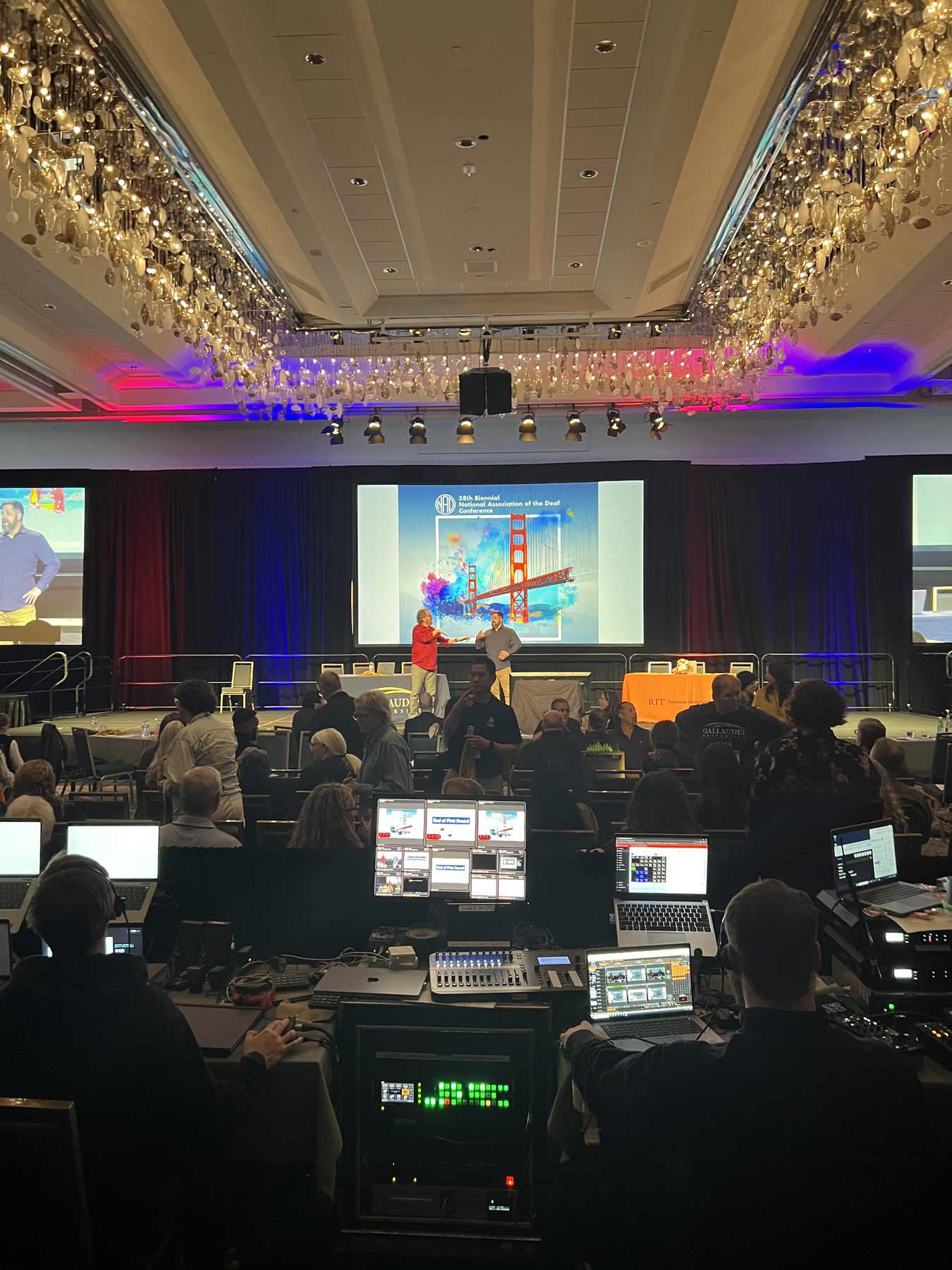
- Left and right stage display outputs in the Grand Ballroom
- Opening Ceremony and Cultural Extravaganza graphics
- Archival video framing and interstitials
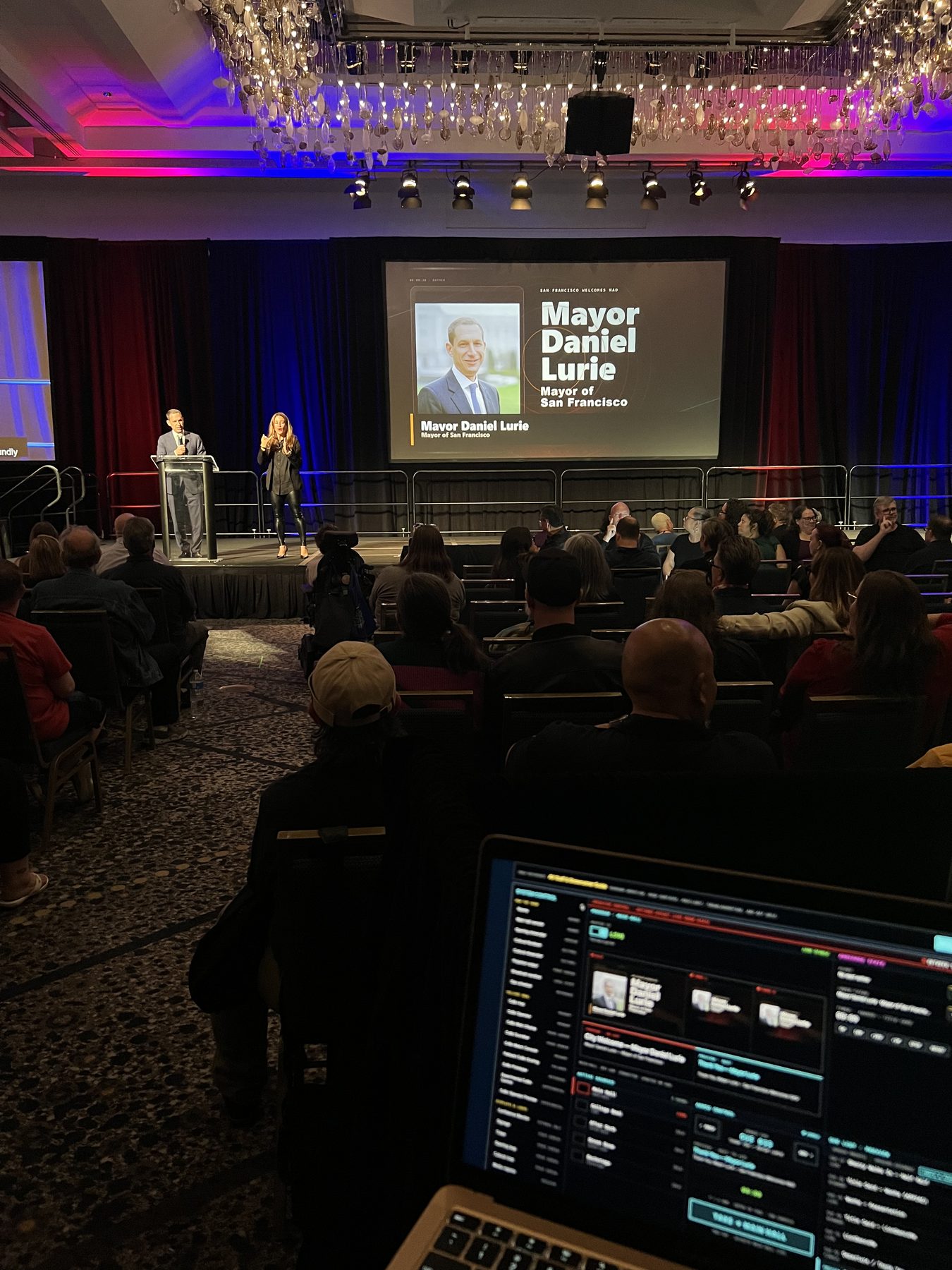
- Speaker cue cards and lower thirds
- Sponsor and identity surfaces
- Operator routes for live control
- Emergency slates and fallback screens
- Workshop and CEU workflow experiments
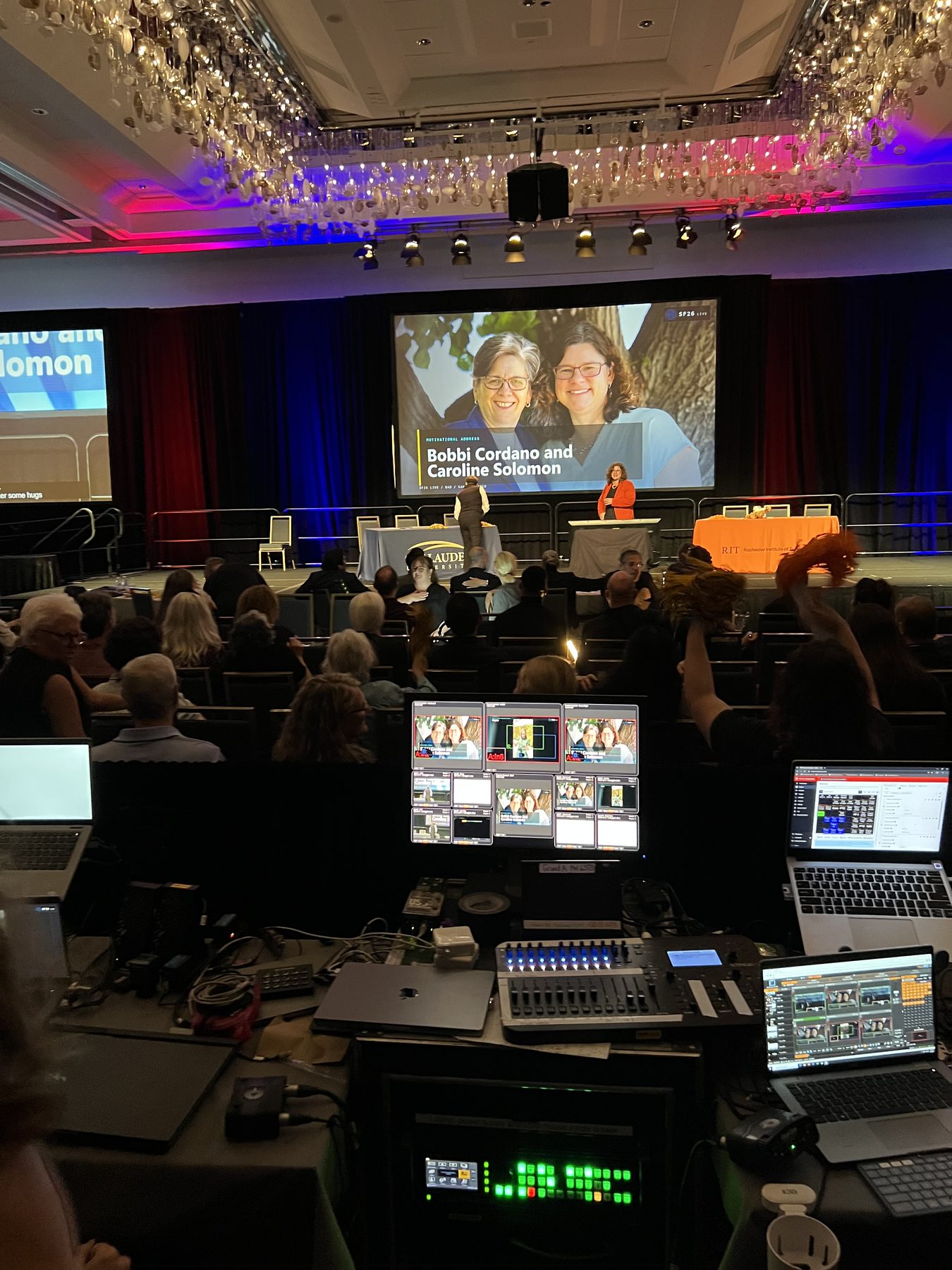
The unifying idea: a Deaf conference can have a single system that combines cultural memory, accessibility, stage production, attendee information, and operational control. Not five vendors and a shared Dropbox. One layer.
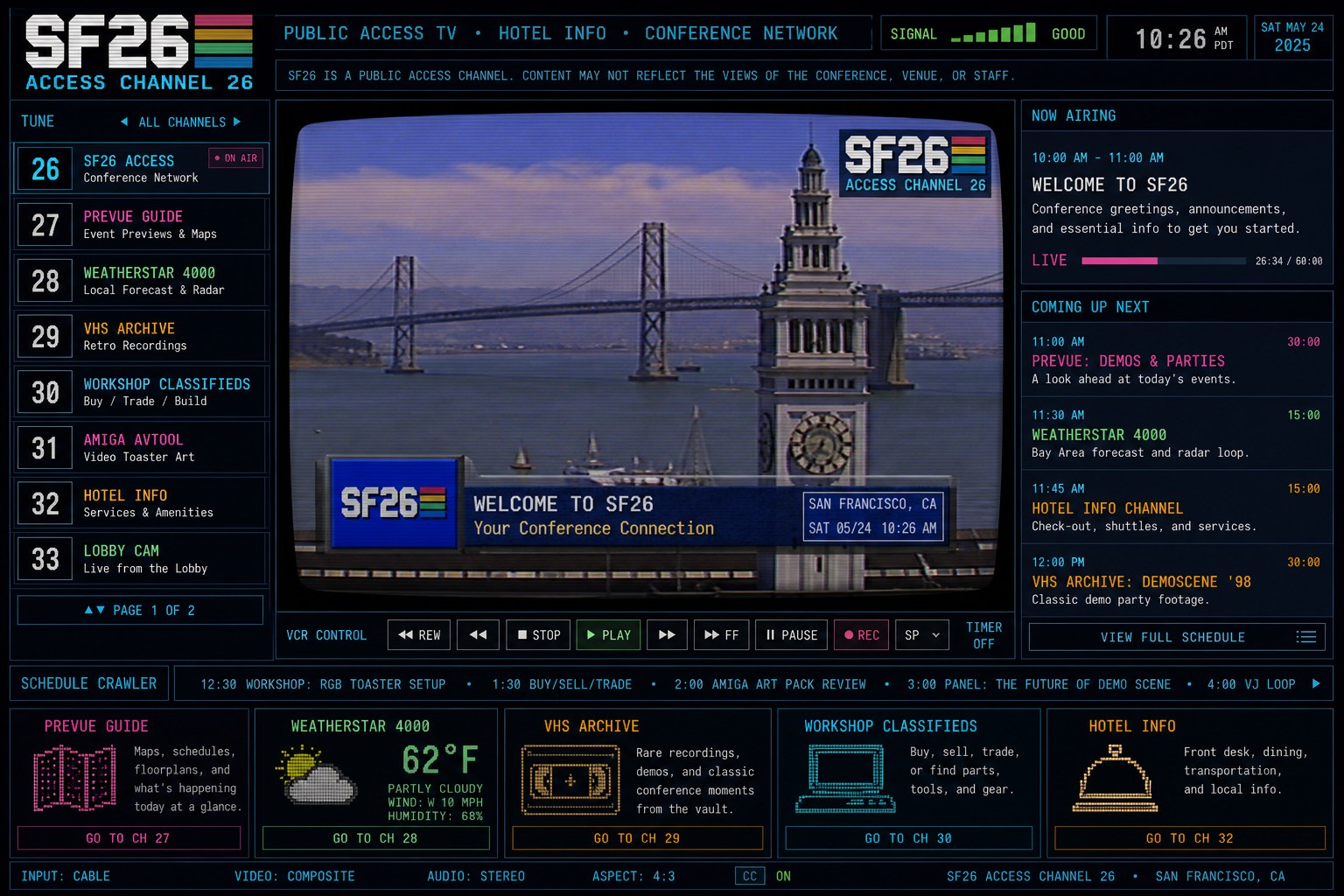
The visual identity leaned deliberately into the community’s own media lineage — public-access frame language, station bugs, VCR-era transitions, an “Access Channel 26” sensibility drawn from the Amiga and Video Toaster aesthetic that powered so much early Deaf television. It read as culturally specific rather than generic conference design, and it held together under real production pressure.
The moment we knew it worked
The conference’s theme, in retrospect, was resurrection. We brought archival Deaf media back into the room — Byron Benton Burnes, Douglas Tilden, Silent Perspectives / Deaf Mosaic energy — not as museum clips, but framed inside a living broadcast environment, staged as present-tense civic memory.
The proof point came from David Peterson, who had hosted the original Burnes and Tilden newscast clips decades ago. He was in the audience. He was, by all accounts, stunned — asking around to find out who had done this. Someone with genuine cultural context looked at the screens and recognized that the archive had been reactivated, not merely replayed.
You cannot buy that validation. It told us the core concept — archival media as live civic infrastructure — is real.
The keeper of the tape
None of the resurrection happens without Dr. Susan Rutherford. For decades she was the driving force behind DEAF Media, the Bay Area organization whose cameras captured Deaf public life when almost no institution thought it worth recording — Silent Perspectives, community newscasts, Feast for the Eyes, the raw material of a broadcast-native culture. When Tom Holcomb connected us in May, we had weeks, not months. What Susan and her husband, editor Rick Clogher, did with those weeks was extraordinary: they went back through their own archive and hand-curated it, delivering roughly 82 hours of footage not as an undifferentiated pile but as an organized, contextualized collection — and then kept digging, surfacing treasures like the 25th-anniversary Feast for the Eyes poster she knew existed and would not stop looking for.
She gave more than footage. On a video call the night before Rick’s surgery — both of them showed up anyway — she gave us the context that turned clips into memory: who was in the frame, what it took to capture, what these recordings needed to become again. All of this while she was a full-time caregiver, still writing to say she’d be available in our crunch time.
When David Peterson looked at those screens and recognized the archive as reactivated, he was recognizing her life’s work. The broadcast layer gave the footage a stage. Susan Rutherford is the reason there was footage at all.
What broke
An honest account matters more than a victory lap, because several things failed or nearly failed, and every failure points at what the next version must be.
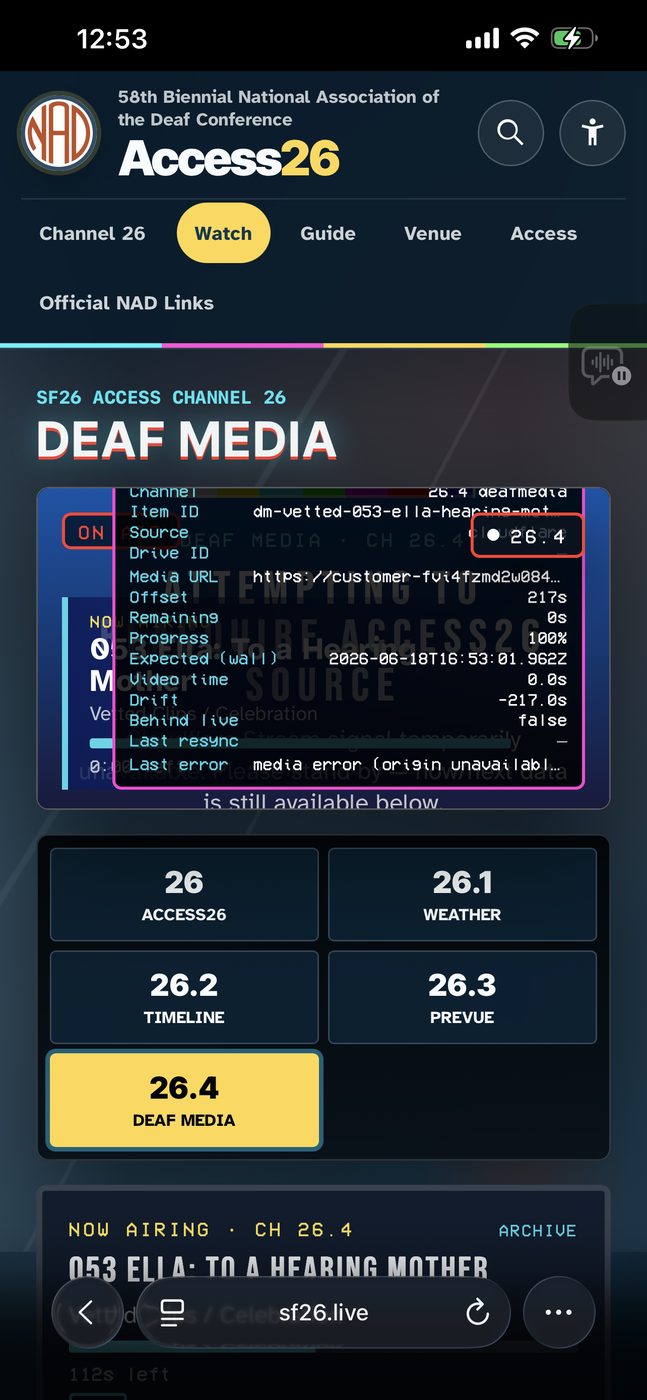
CEU tracking almost collapsed. The QR-based attendance system for continuing education credits — badge payloads, scanner validation, check-in/check-out logic — proved too fragile for live use. Validation rules kept rejecting real scans. The save was a mid-conference pivot to a radically simpler model: capture the badge ID with a timestamp, associate it with a workshop, export the data, reconcile later. It worked, barely. For a professional conference, CEU records are a legal and financial obligation, not a nice-to-have. This must be a first-class, scanner-tested subsystem next time — with a test harness, offline queuing, and operator feedback — not a last-minute patch.
The AV handoff was underdocumented until too late. The system was powerful but not AV-obvious. The production vendor had legitimate questions about display outputs, resolutions, and signal flow that should have been answered by a quick-start packet weeks earlier, not in hallway conversations during load-in.
Content state was fragile. The machinery for driving screens was solid; the actual JSON content feeding it was too easy to corrupt or let drift. Names, titles, timings, and stage-appropriate wording needed repeated manual cleanup. Schema validation, preview dashboards, and a content-freeze workflow would have prevented most of it.
Security boundaries got loose. Under production speed, the separation between public routes, stage routes, and operator routes blurred. Nothing catastrophic happened, but the architecture made it possible to accidentally put an admin surface on a ballroom screen. That possibility has to be engineered away.
And the biggest failure was human architecture. One person served simultaneously as showrunner, systems architect, AV translator, content producer, archivist, emergency developer, and operator support. The system survived because that person showed up in double overtime, repeatedly. Heroics are not an operating model. They’re a warning.
The partner who said yes
None of this worked in a vacuum, and one partner deserves singling out. Encore, our production vendor at the Hilton, met an unusual ask with unusual generosity. When we proposed driving the room from a live, browser-rendered graphics layer — not a stack of pre-baked slides, but HTML rendering in real time — the answer was simply that they could ingest whatever signal we sent, key our lower thirds either way, and had the equipment and crew in the room to run it. That one yes is what made the broadcast layer possible on professional hardware. From there the team leaned in: full stage and house lighting control in Grand Ballroom B so signing stayed lit and legible, a vibrotactile subwoofer rig built around an accessibility use case most vendors have never been asked for, and a project manager who worked our Cloudflare-hosted content system in real time and turned last-minute Cultural Extravaganza media around the same afternoon it arrived. The documentation gap noted above was ours, not theirs — the questions their crew raised at load-in were exactly the right ones. A broadcast layer this ambitious needs a floor team willing to treat it as a partner rather than a problem, and that is what we had.
The real product
Here is the insight worth stating plainly: this is not “conference website work,” and positioning it that way undersells everything.
What SF26 prototyped is an Access Conference Broadcast Layer — a reusable platform sitting at the intersection of SaaS, broadcast production, conference operations, media preservation, sponsorship inventory, and accessibility infrastructure. The natural market is the civic ecosystem this community already runs: NAD affiliates, state associations, Deaf in Government, Deaf Studies programs, interpreter and accessibility conferences, federal convenings.
The value stack is legible: a platform layer (screens, rundowns, operator routes, AV documentation), a creative layer (stage packages, archival treatments, tribute and sponsor media), sponsorship inventory that turns conference screens into fundable surfaces, and a post-event archive package that ensures the media produced at a conference doesn’t die with the conference. Each layer maps to revenue, and each maps to grant-fundable public-interest work: digital preservation, language access, civic participation, Deaf media history.
From resurrection to what’s next
SF26 was about the past returning — ghosts brought back into the room, and welcomed there.
The next iteration, at Deaf in Government’s 2027 National Training Conference in Washington, should not replay that. DIG’s thesis is different: the now and the possible. Deaf civic infrastructure, AI and accessibility, language access as a design authority, federal policy power, youth leadership, Deaf technologists building in public. The visual language shifts accordingly — from hotel-channel retro to civic command center: hearing-room aesthetics, federal wayfinding, live dashboards, the Gallaudet protest lineage rendered as operational power.
SF26 said: we remember.
DC27 should say: we are not done.
Roll the credits
A broadcast layer is a system, but a conference is people, and this one ran on the generosity of many. Bobbie Beth Scoggins, as interim CEO and Executive Producer, gave this work its mandate and its nerve — trusting an unproven system with the biggest rooms of the biennial and backing every ambitious call. Nancy Bloch was the connective tissue behind the scenes, moving sponsor media, partner logistics, and a hundred unglamorous details at production speed. At Encore, Drew Lanning and Joshua Morrison turned “can you ingest a live browser feed?” into “send us the link” — Joshua in particular worked our content system in real time like it was his own. Jennie O’Shaughnessy DeLeon and Jewel Jauregui coordinated the interpreting that kept every production, shoot, and stage moment linguistically whole — access work done so well it disappeared into the show. David Pierce opened his media vault when we needed it. Thomas Holcomb connected us to the SF Bay Deaf community’s living memory — including the introduction to Susan Rutherford that changed the entire arc of this project. And behind all of them: the NAD Conference volunteers, dozens of them, who ran badges and doors and stages and a thousand invisible saves. The screens carried the show. These people carried the screens.
Why this matters
Accessibility work is too often framed as accommodation — a service bolted onto someone else’s event. SF26 demonstrated the inversion: a Deaf conference where the broadcast layer, the archive, the stage, and the operations were designed from Deaf media culture outward, and where the result was better production than the generic alternative, not a compromise on it.
The prototype passed its first live-fire test. Parts of it were held together by improvisation, and we’re documenting every one of those saves so they become runbooks instead of legends. That’s the whole project now: converting heroics into infrastructure — so the next conference, and the one after that, inherits a system instead of a story.